
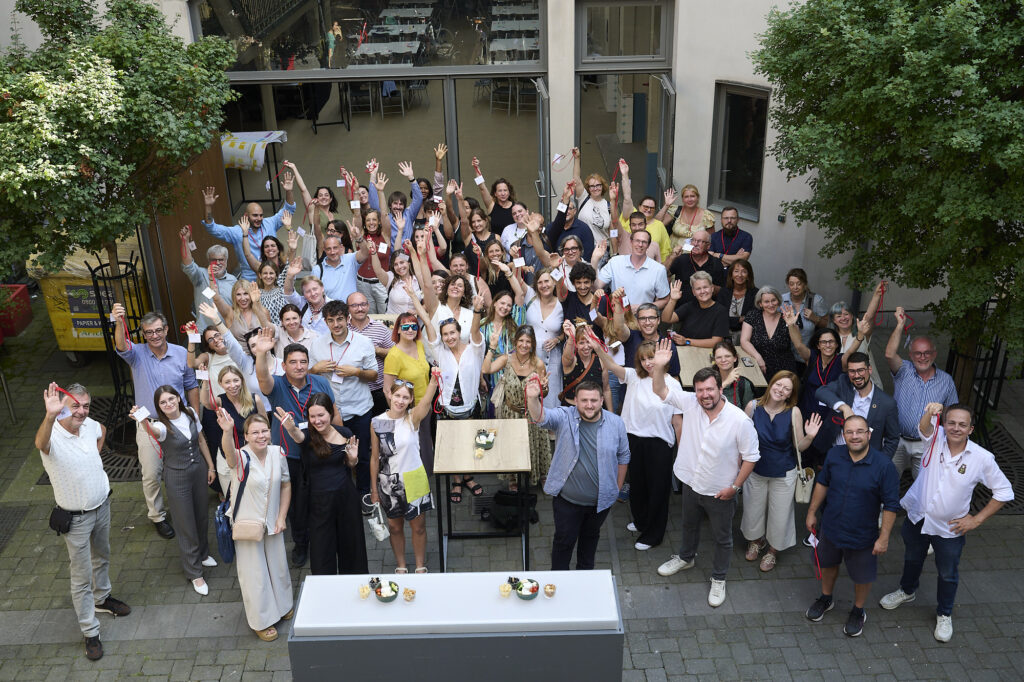
Europe’s digital transition is entering a decisive phase. Artificial intelligence, data governance and digital platforms are reshaping economies and societies, while new European legislation seeks to ensure that technological progress remains democratic, trustworthy and aligned with public values. These questions were at the heart of the DO Impact Final Conference in Brussels, where Baltic InnoLab joined policymakers, researchers, social economy organisations and digital innovation actors to discuss how Europe can build a more resilient and inclusive digital future.
One of the conference’s central messages was that digital transformation should not simply reinforce existing market structures. Instead, technology should empower communities, strengthen democratic participation and create social value alongside economic growth. For Baltic InnoLab, one discussion stood out in particular: the future of social entrepreneurship.
Across Europe, social enterprises play an essential role in addressing societal challenges. However, many organisations remain heavily dependent on public funding programmes throughout their development. While these programmes are indispensable for enabling innovation and experimentation, long-term sustainability ultimately depends on an organisation’s ability to compete in the marketplace, validate its solutions with customers and attract private investment. This remains one of the greatest challenges facing the social economy.
During the conference, participants voiced two complementary ambitions. The first is to ensure that social economy organisations become active contributors to shaping European policies, rather than simply adapting to them. The second is to create Europe’s future generation of social unicorns – high-growth enterprises capable of delivering both commercial success and measurable societal impact. Both ambitions are important. Yet they also raise an important question: what conditions enable mission-driven organisations to scale?
Experience from the broader innovation ecosystem suggests that sustainable growth rarely emerges from funding alone. It is built through continuous product development, market validation, customer feedback, entrepreneurial risk-taking and the ability to adapt quickly to changing conditions. Public support can create opportunities, but long-term resilience requires strong business foundations.
For this reason, Baltic InnoLab sees an increasing need to strengthen the business capabilities of social enterprises alongside their social missions. Digital technologies, artificial intelligence and data-driven innovation offer unprecedented opportunities to improve products, increase operational efficiency, reach new markets and become more attractive to investors. Building these capabilities will be essential if Europe wants more social enterprises to grow beyond local initiatives into scalable, internationally competitive organisations.
The discussions in Brussels reinforced an important principle that increasingly guides Baltic InnoLab’s work: creating impact and building sustainable businesses are not competing objectives. On the contrary, they are mutually reinforcing. If Europe wants more organisations capable of creating lasting social impact, they must have opportunities to grow beyond the greenhouse. After all, neither oak trees nor unicorns flourish there.
Baltic InnoLab would also like to thank the Lithuanian Social Business Association for bringing Lithuanian organisations into these European discussions and creating opportunities to contribute to the future of the social economy.